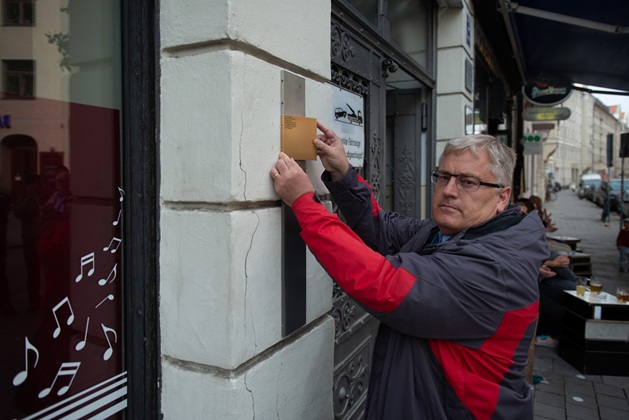
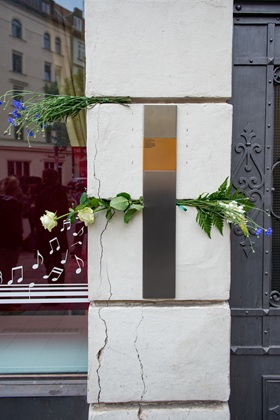
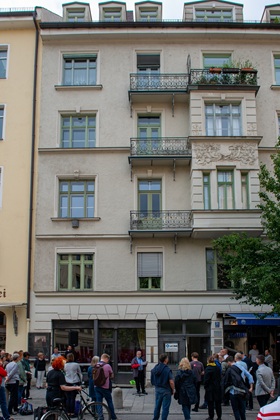
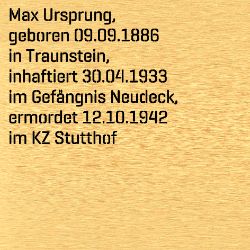
The tin smith Max Ursprung came from Traunstein, but had lived in Freising, Rosenheim, Berlin and Munich. From November 1932, he lived in the rear building at Dreimühlenstraße 28 in Munich. He had been convicted several times for homosexuality. His resident registration card noted that he had to report regularly to the police because of his homosexuality. Shortly after the Nazis seized power, Max Ursprung was arrested in April 1933 and taken to Neudeck Prison.
After five years in Neudeck Prison, the criminal investigation department ordered ‘protective custody’ for Max Ursprung because he was considered a ‘professional criminal’. In 1938, he was taken to the Dachau concentration camp and from there to the Flossenbürg concentration camp in the Opferpfalz. In July 1942, he was brought to the Stutthof concentration camp near Danzig. The transfer list is sorted by ‘craft trades’; Max Ursprung is listed as a tin smith. Presumably, the Stutthof concentration camp had requested prisoners with specific professions.
In October 1941, Max Ursprung died, completely exhausted from years of forced labour and imprisonment in the camp. In the camp doctor's records, the 56-year-old is noted as a ‘frail, old man’ who died of ‘heart failure and old age’.


.svg)